

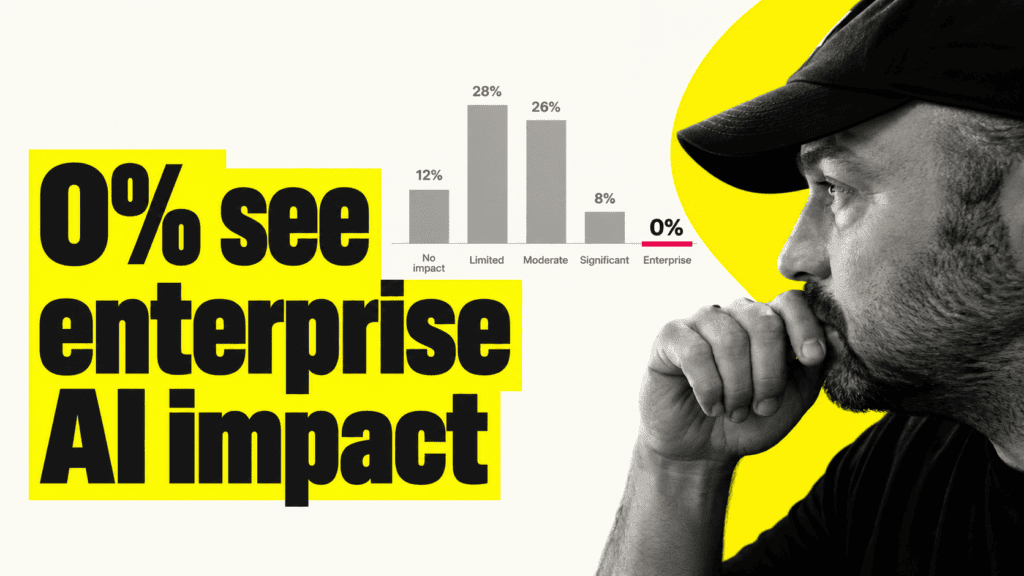
CCW published a report recently that asked contact centre leaders how much impact AI has had on their business. The share of businesses that said it’s had enterprise-level impact was zero. Most sit a couple of rungs lower, at moderate impact with limited operational gains.
So why are so many companies still failing?
In my experience, a crucial part is related to use case selection. It’s one of the 8 reasons AI projects fail.
Most businesses have no reliable way to decide what AI should actually do for them. They can’t pick the use cases with the best chance of delivering value, based on the business problem they’re trying to solve and how ready the technology is to solve it.
So here’s a way to fix that problem. Sounds obvious, but I see this play out time and time again so, seemingly, it has to be said.
Follow the volume
Pull up your call volumes. Look at your website traffic and your chat volumes. You’ll find a tiny number of customer needs representing at least half of your total volume. I’d bet my house on it.
That’s where your use cases are. Find out where the volume is, find out where the pain points are within it, and solve those. It’s literally as simple as that.
You only need to solve part of the problem
Solving part of a high-volume problem is enough to make a difference.
Let’s say a single contact reason accounts for 20% of your volume. Resolve a third of that and you’ve removed nearly 7% of all contacts. Fully automate a niche request that makes up 1% of volume and you’ve removed 1%.
As Andrei Papancea put it: “Even automating 30% of a trivial issue doesn’t move the needle. But solving a small part of a big problem can.”
“We’ve already automated that”
This is the objection I hear most. The business says its top contact drivers are already covered, with automation running on all of them.
If that’s the case, then why are they still your most common contact reasons?
If the problem was solved, customers wouldn’t need to get in touch about it. Sustained volume on an intent tells you the need is still open, whether that’s because self-service isn’t working, the automation only handles the simplest version of the request or customers are coming back a second time.
Before you get too comfortable, check whether customers actually got what they needed and how often they come back. Containment rate alone won’t tell you. In most cases there is plenty of value left on the table.
Three questions to start with
- Where’s the volume? Rank your contact reasons across every channel and see how few of them make up half your traffic.
- Where can we have impact? Within those high-volume intents, find the specific steps that cause friction, cost or repeat contact.
- Where is the technology ready? Match those steps to what AI can reliably do today, in production, with your data and systems.
Where the three overlap is where you start. If you want a head start on the third question, these are the 8 top AI use cases for contact centres.
Your use cases are staring you in the face. Look at why people contact you and solve that. It sounds painfully simple, and it is. Why every business isn’t already doing this is beyond me.