

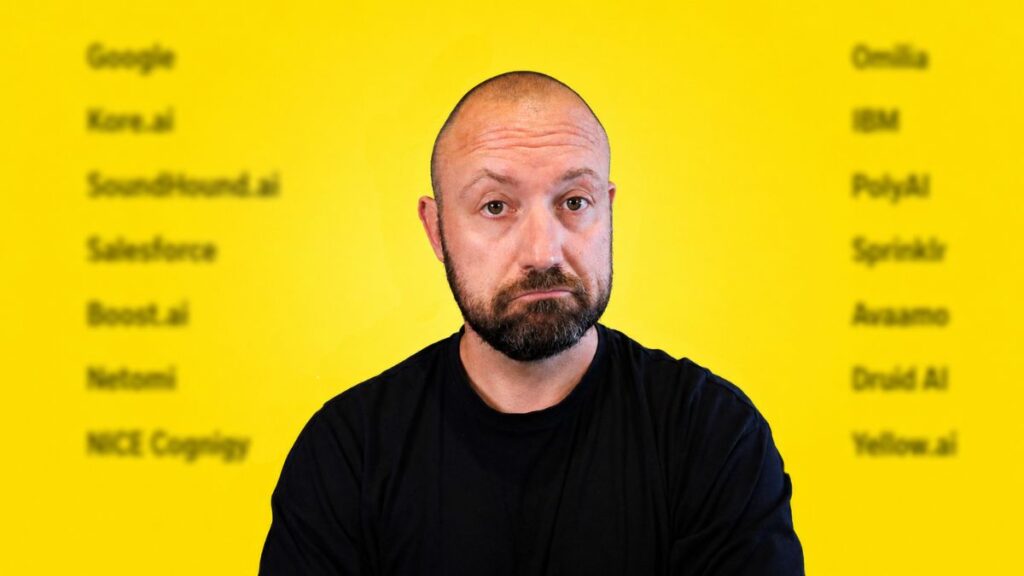
Gartner published its Magic Quadrant for Conversational AI Platforms on July 7, 2026. Benoit Alvarez from VUX Consulting and I are sharing our take on this year’s version of the quadrant. Be sure to check out my analysis of the Magic Quadrant for Conversational AI Platforms from 2025.
Before we get cracking, we have no affiliation with Gartner, so we’re not obliged to tow the line and, while we have worked with, and do currently work with some of the vendors on the list, our appraisal here is our genuine reflections.
Where you should start: criteria
The interesting place to start with this year’s MQ is the inclusion criteria, the stuff that explains who is eligible to feature.
Reading them this year, the first thing that stands out is that voice AI sits in the optional bucket rather than the mandatory one.
For anyone working in this industry right now, you’ll know that voice AI is a key part of the tech stack needed for AI in CX. This year in particular, voice has taken off. Any platform aiming to automate conversations has to be able to run across every channel, including voice. Multi-channel should mean multi-channel. Treating it as a nice-to-have understates how much of the 2026 buying conversation is voice-led.
The second thing is that QA monitoring, observability and optimisation are all grouped together. Including those categories at all is a step in the right direction, but grouping them together means that a vendor with industry-leading observability, but weak testing, can come out looking similar to a vendor that’s moderate in both areas or one that has the opposite strength. Those are three genuinely different disciplines, and they deserve to be scored separately.
Analytics has the same problem, but in a slightly different way. Every vendor has a different view of what analysis means and what constitutes a successful conversation. Scoring a category when the definition varies across vendors means it’s hard to compare.
There are a few other categories that have the same level of opaqueness.
Guardrails are the clearest example. Google’s Conversational Agents platform lets you turn certain guardrail categories on and off, or set values at low, medium or high strength. But what does high strength mean? What exactly are you guardrailing against? And is that consistent across vendors?
Debatable criteria
Then there are criteria I am less sure about. For example, AI-assisted coding is an optional feature, as is pro-code. That means the mandatory position for vendors on the MQ is that you have to have a no-code or low-code platform. That rules out companies like Rasa, not because of a lack of capability, but because of how they’ve decided to build and who they’re building for.
Another thing I’m on the fence about is that the prioritisation of vendors is often as much about the company’s market position than it is the platform. For example, some vendors target specific industries. Avaamo is heavily involved in healthcare. Boost.ai is heavily involved in financial services and other regulated industries. Neither focus stops those platforms from serving other verticals. Nor does it affect the capabilities of the platform. If you lined up a hundred industries and asked which would find the most value from AI fastest, then financial services and healthcare would be among the top few. Going where the opportunity is looks like good business to me, not a limitation.
Where everyone landed
Four Leaders: Google, Salesforce, SoundHound AI and Kore.ai
Two Challengers: Boost.ai and Netomi
Three Visionaries: NiCE Cognigy, Omilia and IBM
Five Niche Players: PolyAI, Sprinklr, Druid AI, Avaamo and Yellow.ai
Salesforce and Netomi are new entrants. SoundHound has moved up. Boost.ai was a Leader last year and is a Challenger this year. NiCE Cognigy has come down on the ability to execute after several years in the top right. PolyAI has moved up and now sits close to the centre. Kore.ai has been in roughly the same place in every edition of this quadrant so far.
On Google, my honest read is that the placement reflects position in AI more than the tooling. Google has its own models, its own cloud infrastructure and every layer of the stack built in-house. I have a soft spot for Dialogflow CX, and, in principle, it is not a bad platform. The blend of generative and deterministic is there. However, the tool is complex for anyone new to it.
Salesforce is the placement that surprised Benoit most, to the point of asking whether Salesforce really offers a conversational AI platform. Agentforce is the answer, and Salesforce has signed an agreement to acquire Fin, formerly known as Intercom, for approximately $3.6 billion. That deal was announced on June 15, 2026 and had not closed when the Magic Quadrant was released.
SoundHound is now a stack of acquisitions. It started with on-device voice AI, closer to music recognition, then built proprietary voice models and went large in automotive. Since then, it has acquired Allset, Amelia and Interactions, and in April 2026, announced the acquisition of LivePerson, its fifth deal. As a company, in terms of culture and history, it is extremely capable and, along with PolyAI and Omelia, it is one of the three on this list with its own models (outside of the Google’s of the world). Applying that to customer experience while integrating four acquired businesses is a real challenge.
That point about specialism matters more than it sounds. A speech recognition model operating over a phone channel on an eight-bit signal, focused solely on speech and conversation, and tuned for particular industries and product names, is not something you get out of the box.
IBM being placed as a Visionary is the one Benoit and I both struggled with. Benoit started working with Watson when it was a server in a New York office. Watson Assistant was strong a few years ago and is still used by many companies. Where the roadmap goes next and where the generative story is are not visible from the outside. As an onlooker, it doesn’t seem as though a great deal has changed, but I’m happy to be proven wrong on that.
PolyAI is a company I’ve always been a fan of. It is a research-led company, close to a mini OpenAI in character, and its Raven model has been trained on millions of conversations rather than fine-tuned at the surface. My recommendation on PolyAI is specific: use a company like that when you want the problem solved for you, rather than wanting to build. That is a different proposition to Google, Kore.ai or Boost.ai, where you buy the platform, bring your own team and build on top. That said, Poly AI has released a user-facing version of its platform and so all that could be about to change.
Druid AI has been around a long time, is highly capable, integrates generative AI well, and has real depth in QA and analytics.
The crucial requirement that the report does not contain
This is the part I would want a buyer to take away. There is a selection criterion missing from this report, and it is the one that decides most deployments: the relationship you want with the provider, and the skills you already have.
Some of these platforms assume you have a team, competencies and the appetite to build. Others assume you want the outcome delivered. Within the first group, there are highly technical and less technical teams, which shape where you should go. Two vendors can sit in the same quadrant position and be completely wrong for each other’s customers.
Benoit pointed out that if a large bank asked him where to go, several vendors would be off the list before he even looked at Gartner’s criteria.
A mention for those that didn’t make it: Other AI vendors to consider
Cresta, Sierra and Glean are not on the quadrant. Parloa, Rasa, Sierra, Decagon and Microsoft get honorary mentions further back in the report without reaching the quadrant. Vapi and Voiceflow do not appear.
Decagon is riding the hype and getting the attention that comes with it, and OpenAI endorses them regularly. If they have an Achilles heel, it is the all-in commitment to generative AI. There are still situations where you want to select the right tool for the job. I have seen Pypestream handle payment card capture in a chat widget by showing a card graphic with the number field where you expect it, and a healthcare flow where the user clicks the part of a body diagram that hurts. Turning dialogue into the right interface at the right moment is not something end-to-end generative systems do yet.
Rasa earns its mention because it is foundational and has kept pace with evolution. What I have always liked about Rasa is that it approaches the problem with conversation quality first and works backwards to the technology. Benoit sees the same trait as a weakness, arguing they lack pragmatism and that a conversation being good rather than great is acceptable for many companies with ten other, more important things. The challenge I see is that it remains a developer platform, and the people with the ear for great conversation are often designers rather than developers.
Sierra is heavily funded and well-connected, and from what I have heard, it is RAG-first, with agentic and automation features arriving fairly recently. Benoit’s concern is that plenty of people know the founder, and comparatively few can describe the product, which suggests the marketing is working, but there could be some dragons in the cupboard. Though I’m sure the product is evolving rapidly.
Voiceflow’s new version, released this year, handles agentic frameworks well, and Benoit rates it above several platforms that made the quadrant, for organisations investing hundreds of thousands rather than tens of millions. What holds it back from proper enterprise deployment is the voice infrastructure. Kore.ai, Boost.ai, PolyAI and NiCE Cognigy have their own, so they can monitor calls, detect dropouts and trace interactions end-to-end. Grabbing a Twilio number and borrowing infrastructure you do not control are different propositions. Many companies do it, but the ones reaching scale have a deeper integration capability.
Is this becoming a contact centre quadrant?
NiCE acquired Cognigy in September 2025. Cognigy as a platform remains independent today. You can build what you want, deploy in any channel and use it as you like. The direction of travel over time is towards tighter coupling with NiCE’s contact centre.
If the largest vendors in this quadrant are contact centre companies, this starts to look like a contact centre platform quadrant. And if that is the case, Zoom belongs in the conversation. Zoom acquired Solvvy in 2022 and built out an agentic layer and its own models rather than sitting on it. I would put Zoom below Cognigy on AI capability and it is still making real progress, and we have a client running Zoom Virtual Agent with good feedback. Zoom is absent from the quadrant and from the honourable mentions.
We have also seen what the platform does at scale. In our virtual session, Scaling to $5bn with AI: the SharkNinja story, Damian Hall, Senior Director of Global Consumer Experience at SharkNinja, outlined how the company deployed AI across agent productivity, customer interactions, service operations, and business value, in partnership with Zoom.
I pulled distinct use cases from the session into a separate write-up: 10 ways SharkNinja uses AI to support a $5B business.
The vendor I expect next year is Amazon. Lex is what it is, Bedrock is being used heavily, and AWS acquired NLX in April 2026. The NLX team know this space properly. Amazon has all the component parts but has not yet assembled them into a single package. Given ownership and responsibility, that team could change the picture.
How you should read this report
Read the criteria first. Work out which of them matter to you and which do not. Then read the placements knowing that a chunk of the score reflects company scale, geography and funding rather than what the software does on a Tuesday afternoon.
And answer the question the report does not ask. Do you want to buy a platform and build, or do you want someone to solve the problem for you? That answer narrows the field faster than any quadrant position.
All in all, congrats to Gartner on pulling it together. It’s a big lift and takes a lot of effort. And well done to all those who made it. Hopefully, it helps businesses make the right decisions now that AI has moved from optional to mandatory.