

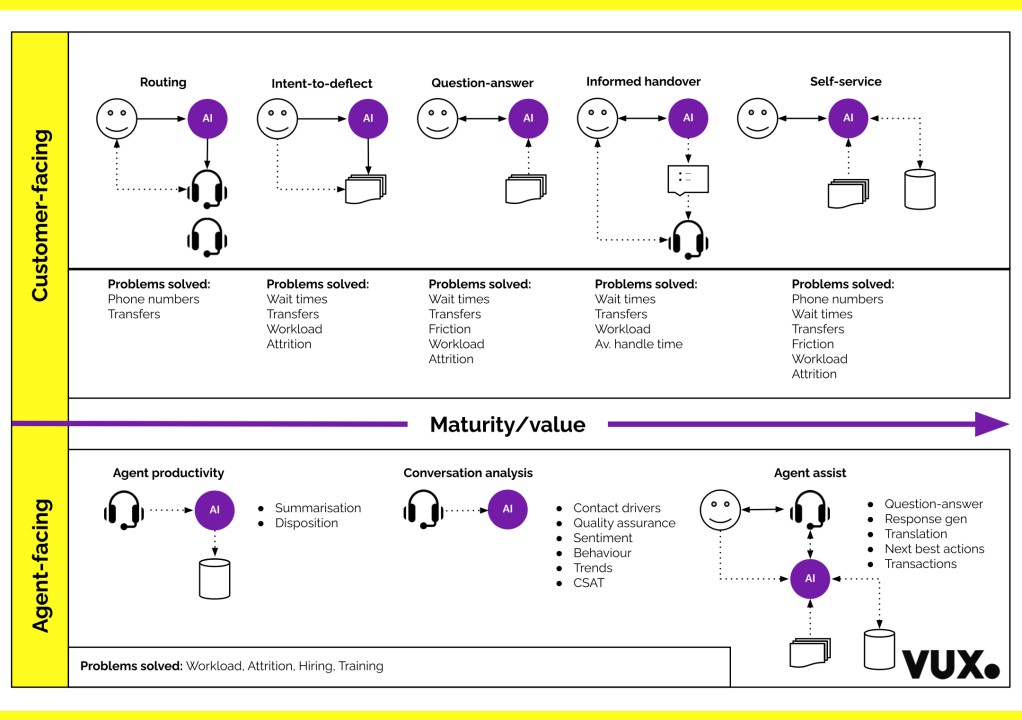
I recently gave a talk at a webinar, hosted by Servion and Cisco, where I laid out the top use cases for AI in the contact centre. I’ll share them with you here.
I’ve said it before and I’ll say it again: the contact centre is where the big opportunities lie for AI. Here, we have the perfect mix of business appetite, technology readiness and customer value. It’s a no-brainer.
This run through should help any contact centre or CX leader understand where and how AI can help you improve customer experience and increase operational efficiencies.
1. AI-Powered Routing: Finding the right agent
The first AI application is intelligent call routing. Traditional Interactive Voice Response (IVR) systems, which require customers to navigate through a series of options (“Press 1 for X, Press 2 for Y”), can be replaced by AI assistants, capable of understanding natural language.
Customers can simply articulate their needs and the AI will direct the call to the most suitable agent.
This not only simplifies the process, eliminating the need for multiple phone numbers, but also significantly reduces call transfers, enhancing customer satisfaction and operational efficiency.
2. Intent to Deflection: Guiding to the right channel
Another use case is what I call ‘intent to deflect,’ where AI identifies the nature of a customer’s request and redirects them to the most appropriate channel for them to resolve their need.
For example, let’s say you have a perfectly working journey for ‘change of address’ online; all other channels should guide users to the online journey for that need. You can do this by recognising the user’s intent, then sending them the link to the appropriate journey. If you’re on a channel where this isn’t possible, then send the link via SMS to the customer to complete the action.
Here, AI can help in reducing wait times and agent workload, effectively filtering out calls that can be resolved through existing self-service options.
3. Question-Answering: Dipping your toes into self service
This use case is where a user and the AI have a dialogue and the AI is able to answer questions directly within the conversation.
It’ll do this by having access to data repositories, such as your CMS or knowledge base. Sometimes, you’ll combine use case 2 and 3 so that the agent will answer questions, until it reaches a point of action, then it’ll guide the user to the channel of choice for fulfilment.
This not only slashes wait times but also cuts down on agent workload by handling repetitive and simple queries.
4. Informed Handover: Smoothing the transition to human support
For issues that require human empathy or complex problem-solving, you can use AI to facilitate an ‘informed handover’ to live agents. By having a preliminary dialogue, an AI assistant can collect information from customers, then hand that information over to the appropriate agent to finish the call. This could involve taking down details, or performing tasks like user authentication.
This preparation enables agents to address customer needs more efficiently, improving resolution times and reducing the overall burden on customer support staff.
5. Self-Service Integration: End-to-end fulfilment
The pinnacle of AI application in contact centers is in conversational self-service systems. These systems integrate with core business platforms, such as CRM and line of business systems, allowing for comprehensive, AI-driven customer support. This approach transforms typical self-service journeys into a natural conversation across any channel.
This significantly reduces the need for live agent intervention and enhances customer satisfaction through swift resolutions.
6. Agent Productivity: Post-call wrap up
Beyond customer-facing applications, AI can also play a crucial role in augmenting agent productivity.
After the call, you can use AI to summarise calls, write these summaries in to systems of record, and generate post-call disposition codes.
I tend to think of this as low hanging fruit and not revolutionary. However, if you have a contact centre with hundred of agents and thousands of phone calls, knocking 30 seconds per call of the back will add up to some serious productivity gains.
7. Conversation analysis
Another post-call use case is using AI to help managers and supervisors with things like quality assurance and insight generation.
AI can analyse conversations for quality assurance, making sure your agents are following policies and legislation. It can be used for sentiment analysis, to figure out whether you’re delivering delightful experiences. Monitoring behaviours to identifying training opportunities or to identify techniques of high performing agents, find trends among customers and predict CSAT and NPS scores, removing the need to ask people for feedback and increasing accuracy at scale.
This all not only streamlines administrative tasks but also offers actionable insights into customer behaviour or and service quality, enabling continuous improvement.
8. Agent Assist: Empowering agents with AI support
The ‘Agent Assist’ use case exemplifies AI’s potential to transform the agent experience. By interpreting customer-agent interactions in real time, AI can offer suggestions, automate customer response generation, enable translation between languages, provide next best actions and coaching, and even fulfil end-to-end transactions. No more swivelling between multiple systems.
This can significantly reduce the effort required from agents. Not only can it enhance the quality of customer service, but also minimise the need for extensive training and system navigation, allowing agents to focus on delivering personalised support.
Enhanced efficiency and satisfaction
The integration of AI into contact centres promises a future where customer interactions are more efficient, personalised, and satisfying. This is already playing out.
Depending on your stage of maturity, you may employ one or many of these use cases within your solution. By leveraging AI across a spectrum of applications—from intelligent routing to comprehensive self-service and agent support—businesses can significantly enhance their operational efficiency and customer satisfaction.
As we embrace these technologies, the role of contact centers evolves from mere problem resolution to delivering a seamless, engaging customer experience, marking a new era in customer service excellence.