

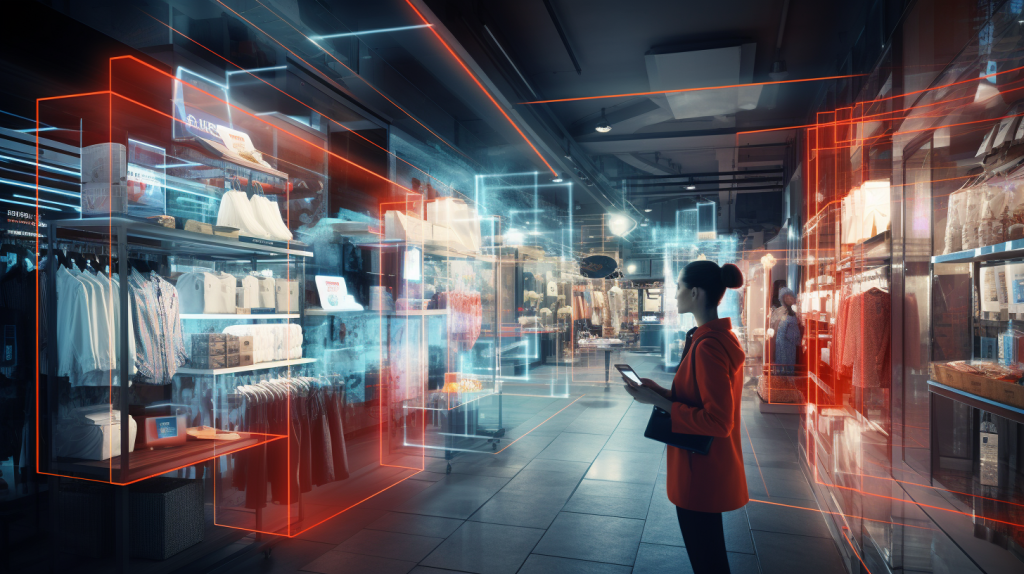

The advent of AI has all industries pondering the transformative potential. And retail is no exception. As digitalization is rapidly reshaping the retail landscape, we delve into three unique ways that artificial intelligence is being used in this sector, focusing on areas such as enhancing in-store experiences, improving customer phone interactions, and personalizing online shopping journeys.

“Retailers have not evolved, both from a tech stack perspective, or from a people perspective to serve this kind of customer demand. On-demand, anywhere, anytime – they want to buy products and get services. So it’s only possible by creating digital channels to enable that scale of retail.”
That’s according to Gopi Polavarapu, Senior Vice President and General Manager at Kore.ai, who spoke all about it with Kane Simms during their recent chat on VUX World.
1. Empowering store associates with instant information access
The retail industry often sees high staff turnover, with employees frequently moving on to other opportunities due to a perceived lack of support. Yet, consumers often rely on store associates for product information and advice.
Gopi told us about Retail Assist, a solution that brings AI to the fingertips of in-store employees. It allows employees to ask an AI-powered digital associate about products, so they can instantly provide answers to customers. They can find information like where products are located and if the items are in stock. This tool can be as useful to a new hire as it is for an experienced salesperson.
Plus, it runs on almost any device. Zebra tablets, mobile, even on Motorola walkie talkies!
2. Overcoming challenges of in-store phone support
Have you ever called a local store and not had your call answered? Maybe a more unlikely scenario is that you call a local store and the call is answered!
Gopi shared with us how a significant percentage of retail calls go unanswered. Apparently, that’s up to 40%. This can be worse during peak periods and could mean your customer’s need goes unresolved. Maybe they’ll call a competitor instead?
While a brand’s contact center might have already implemented conversational AI in the contact center, voice automation for local stores is often overlooked. Those store phone lines could also be automated, so that every call is answered, and every customer’s need is assessed and resolved.
Gopi shared with us how RetailAssist provides this capability for retail, the central idea is transferable across all industries and brick and mortar locations.
“You can automate those calls coming in – at least understand what the customer is saying, and take those orders that you’re not currently taking – so that the customers are not going to a competitor.”
This means that instead of answering every call that comes in, the phone line only rings when there’s a customer who needs something that can’t be solved by automation.
3. Orchestrating customer journeys across multiple touch points
With the proliferation of online shopping, the customer journey has become more complex. Consider the stages involved in buying a TV online: browsing, selecting, purchasing, and potentially requiring post-sale support. This journey can span across various websites at different times and with multiple companies involved.
Gopi walked us through how artificial intelligence could play a role in ensuring these transitions are smooth and personalized to each customer. He shared a vision for an orchestrated customer journey such as this:
As Gopi says, “I think we’re not trying to automate everything. That’s the good thing here, right? We’re trying to augment people with technology.”
Unlike a search engine where you make a request and receive multiple results (which you then need to assess for relevance), the aim here is to provide specific answers that serve each customer, every time, at any time, on any channel.
Taking steps towards innovation
We’ve explored just a few examples here from our interview with Gopi, highlighting the potential that AI holds for the retail industry. Whether it’s about enabling staff with on-demand knowledge, ensuring efficient customer phone interactions, or personalizing online shopping journeys, AI could change the face of retail in some truly innovative ways.
Who’ll be the first retailers to come out of the gate with true end-to-end AI solutions? Let’s see.
Thanks to Gopi Polavarapu and Kore.ai for showing us RetailAssist!