

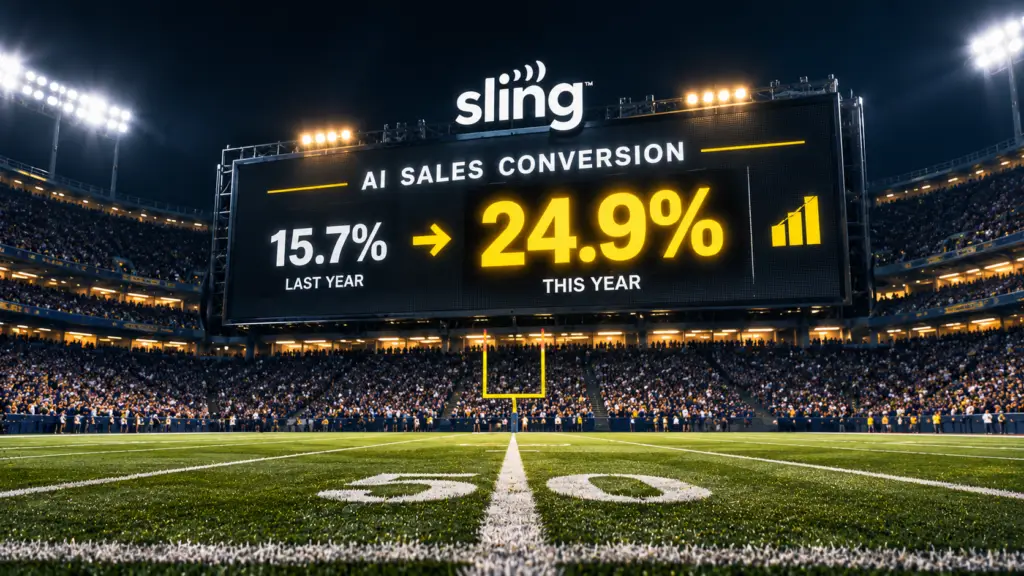
Sling TV’s AI agent converts nearly 25% of sales conversations and the team behind it shared how it grew from answering simple questions to selling at scale.
Sling TV’s results, a year on
Sling TV, the live TV streaming service that is part of EchoStar, has nearly 2 million customers. Its AI agent, built with Pypestream, handles everything from “is the game on?” to signing up, paying and fixing account issues.
Sling’s figures for Q3 2026 compared to last year show:
- Sales conversion rate up from 15.7% to 24.9% on sales conversations
- Resolution up from 36% to 71%
- CSAT up 30 points, from 42% to 72%
- Understanding up from 85.2% to 89.9%
- Escalations down 29%
Containment peaked at 77.5% in September 2026, during football season, handling more than 25 use cases and 50+ integrations.
I hosted a webinar on 10 November 2026 with the people behind the success: Seth Van Sickel (SVP Video and Streaming Services, EchoStar), Jana Johnson (Sr Manager Digital Care and Operations, EchoStar) and Richard Smullen (CEO, Pypestream).
Here are the key lessons in going from answering to selling.
The solution
The session opened with this demo:
A prospective customer asks where the Patriots game is showing. The AI agent finds the package, checks the ZIP code, collects their details, takes payment and confirms the subscription, all within the conversation. Then, the customer adds an extra in the same chat.
Very few companies trust an AI agent with answering basic questions, let alone selling!
Most of what Sling learned getting there applies to any team.
Start with the customer problem
Seth said the work with Pypestream began nearly 10 years ago, shortly after Sling launched, to help customers whenever they needed it. “A lot of those moments that matter from a TV perspective do happen on nights and weekends,” he said. The goal was to “get your issue fixed, get your question answered and get you back watching as quickly as possible.”
Jana’s team started with data. They could see “this large chunk of people that keep escalating” and went looking for the pain points behind it. When they asked customers about how they’d prefer to have their issues resolved, phone or chat, “overwhelmingly, their response was, I just want an answer.”
That answer became the brief for Sling’s first experimentation with generative AI agents.
Earn trust with low-risk steps before you sell
Sling’s first generative AI release was an agent-facing summarisation solution.
Jana said they “played it safe for a couple of months” with agent-facing summaries, to reduce risk, check the intent mapping and answer accuracy. “I didn’t want to show a customer, sorry I don’t understand, can you try that again. That was the dreaded response.”
Live human agents said the summaries saved them effort, so the team moved on to putting simple questions-answer scenarios in front of customers. Cancelling, upgrading, subscription questions. “You shouldn’t have to wait to talk to a person just to change your password,” Jana said. After that came what she called “the big ticket item”, an end-to-end sales conversation with a customer.
Legal sign-off came through the knowledge source. The agent’s RAG (Retrieval Augmented Generation) solution ingests Sling’s public help centre, content that customers can already read. “That really goes a long way with getting buy-in from legal and from your other departments,” Jana said. The team added the right disclaimers and let the agent prove itself. “I think the best persuasion is just try it.”
Each step earned the right to take the next one.
Use the right tool for each step of the journey
Moving into transactional journeys requires more than simply ingesting help desk articles, however. Successful conversations are based on diligently designed customer journeys.
Richard sees every customer interaction as a map. You define the outcome you want (the north star) and work backwards from it. “AI for the sake of AI is not helpful to anybody,” he said. “The outcome as quick as possible is helpful to everybody.”
Working backwards from the ideal experience means you choose deterministic or probabilistic elements for each relevant stage of the journey.
Sling’s agent uses generative AI to understand what the customer wants and deterministic elements to maintain workflows and capture certain required data, such as emails, addresses and payment details. Jana’s team made those payment forms branded and polished so that customers “feel comfortable and confident putting their payment information in there.”
Richard and I covered this design-first approach on The VUX AI Podcast back in 2024.
Richard said it also simplifies approvals, because you know which part each team has to sign off. The payment step is gated so it “can’t deviate”, which gave finance a clear, contained thing to approve.
Treat sales and support as one conversation
The jump from 15.7% to 24.9% chat sales conversion came from iteration. “Everything you’ve seen is iterative,” Jana said. The team looked at the numbers, suspected the first payment form was costing customer confidence, tested a new design and saw an increase.
The bigger lever is how Sling thinks about selling. “Within Sling specifically, care is sales and sales is care,” Jana said. Support can lead to a sale, and every sale needs looking after. The team aims for first-contact resolution. “When they come through that funnel, it’s not the focus of let’s sell you something. It’s the focus of let’s inform you and educate you.”
Seth goes further. When Sling isn’t showing the game a customer wants, the agent points them to the service that does, as quickly as possible. I asked whether that means sending customers to competitors. “Absolutely,” Seth confirmed.
A customer who buys the wrong product comes back unhappy, then buys the right one elsewhere anyway. Seth’s perspective is a refreshing one in that Sling would rather send business to a competitor and head that off at the pass, rather than mis-sell a customer something it can’t deliver on, and deal with the repercussions later.
Build the data and infrastructure for peak demand
Live TV makes demand spiky, driven by sports and news. Seth said the system has to scale from “zero to thousands really in a matter of seconds” as people try to sign up minutes before a big game.
Richard said Jana’s team refreshes the help content every morning, so the agent always works from the latest information in one source of truth. Pypestream plans DevOps capacity and security checks against at least a three-month calendar of sports and events.
The Sports Concierge needs people too. Jana said someone on the team reviews all the games coming up every week to keep answers accurate. Keeping agents fed means building the infrastructure for it, and Jana called the ability “to create APIs and MCPs and things that will continue to fuel your AI agents” paramount.
Going live is the starting line
“AI is not set it and forget it,” Jana said. “AI is not a light switch that you turn on and then it just works.” A content analyst on her team works with Pypestream weekly, sometimes daily to keep on top of performance and identify issues and improvement opportunities.
Richard commented that, when you go live, it’s the first time you have the opportunity to test your assumptions. This is why the numbers we referenced at the outset have climbed, rather than stalled.
Parting lessons
Jana’s parting lesson was to “get a baseline of metrics and then establish a goal for success and keep that monitoring schedule.” Her hunch is that many failed pilots launched without one, so teams don’t know when or how to iterate.
Richard’s lesson was to find a partner “highly invested in the outcomes” that can test your assumptions in real time and make changes with you. “Launching, this is the starting point,” he said.
Sling’s results come from slower work: journey mapping, baselines, deciding where generative AI fits and where a simple form does the job, then improving every week.
It was a pleasure to have an inside look at what it takes to scale revenue-producing AI agents with Sling and Pypestream, and you can replay the full discussion on demand right now should you wish.