

In our previous article, we explored why Test Driven development (TDD) is making a comeback in AI agent development. As agents become more capable and autonomous, testing needs to become part of the development process, not something that happens at the end.
But what does AI agent testing actually look like today?
A rapidly developing market
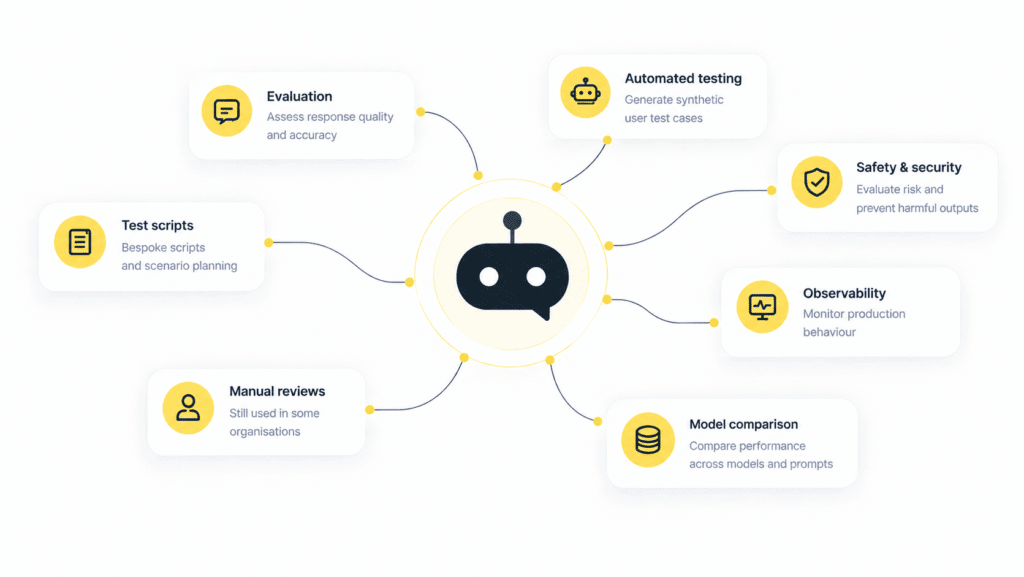
The AI testing market is growing quickly. What once relied heavily (and sometimes still does in certain organisations) on manual conversation reviews and bespoke test scripts has expanded into a growing ecosystem of evaluation, automated testing, observability and security tools.
There are now ways to assess response quality, generate synthetic user test cases, evaluate safety, monitor production behaviour and compare how agents perform across different models, prompts and data.
The market is moving fast. But there is a catch.
“AI testing” means different things
There is no single test that tells you whether your AI agent is reliable.
One approach might evaluate if a response is accurate. Another might assess if an agent selected the right tool. Another might test if it can resist an adversarial attack.
All of these are useful. But they answer different questions.
And this matters because a good individual response does not necessarily mean a good customer experience.
Testing the response isn’t testing an agent
Imagine an agent gives a perfectly accurate answer to a customer’s question, but fails to complete the customer’s task. For example, when a customer says “upgrade account” and the AI agent (capable of executing the task) only gives instructions on how the customer should do that.
Or it completes the happy path successfully but gets stuck when the customer changes their mind or makes a mistake.
Or it works when a customer uses the expected wording, but sends the same request to the wrong sub-agent when they phrase it differently.
The individual response might look fine in isolation. The overall interaction isn’t.
For AI agents, reliability depends on much more than the quality of what the agent says. It depends on what it does, how it responds to unexpected behaviour, and whether it ultimately achieves the intended outcome.
The challenge for organisations
The question is therefore shifting from:
“Which tool can evaluate my AI?”
to:
“Do I have a complete approach to testing my AI agent?”
That means understanding which behaviours need to be tested, at what stage of the development, and what constitutes a pass or fail.
It also means testing both the behaviour the team designed and what happens when customers don’t behave as expected.
What comes next?
The market now offers the building blocks needed to test AI agents. The harder part is putting them together into a testing approach that gives teams genuine confidence before an agent reaches customers.
In our next article, we’ll look at what that approach looks like, from development testing through to stress testing and go-live.
In the meantime: how many types of tests are you covering? Take our quick assessment and see where you are: Start Assessment