

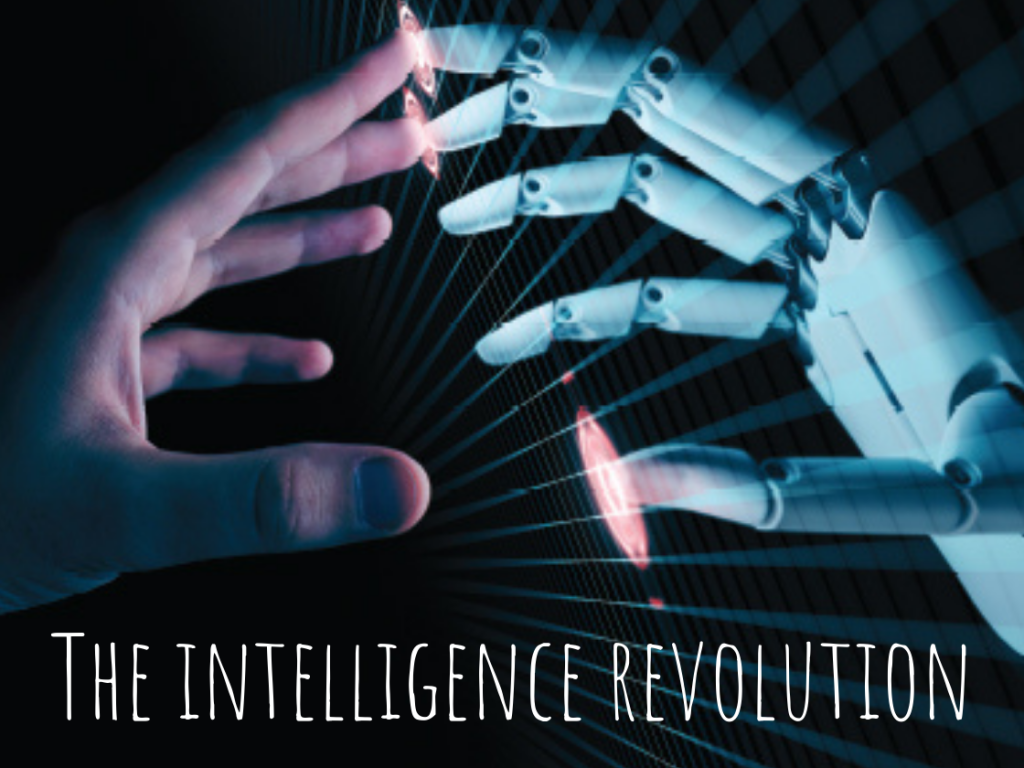
Did nobody tell you there’s a revolution going on? It’s actually the next stage in a sequence that started long ago.
The world had the agricultural revolution, where farming productivity increased. More people could be fed and populations swelled. We had the industrial revolution, hundreds of years ago, where the scale of manufacture greatly increased with new innovative machines and methods.
Then, there was the information revolution. Don’t worry if you didn’t notice because you were too busy googling – that’s exactly what the information revolution was! You were experiencing the way the internet gave you access to vast amounts of catalogued information.
The next important revolution was brought up by Scott Stephenson from Deepgram during his chat with Kane on VUX World.
Processor fans spinning like wheels on carts
So what revolution are we now experiencing? According to Scott, it’s the ‘Intelligence Revolution’.
Whereas the information revolution brought vast amounts of data to humans, we’re now in the time when we can use deep learning to sift through that data to help humans understand it. Intelligent ways to sort information and infer meaning to it.
So can we all pop monocles over our eyes and chat knowledgeably about life while our digital gophers sort information for us? Well, sadly not yet. We’re still in the early days. Much has to be invented for us to realise the potential of this new age.
But it has seismic implications for you, me and everyone.

Gleaming insights
It’s generally accepted that computers are better at some menial tasks than humans. When you have a lot of data that needs to be sorted, a computer will do it best. On the other hand, if the task requires creative imagination, humans have the upper hand.
We can see this in action already. Call centres can now use AI to understand callers first, define their problem, and then pass the caller onto the best agent for the job. If that only saves users a few seconds per call then, it equates to massive savings at scale. All agents are dealing with the issue they’re best suited to. Money is saved.
A reshaped world
Each revolution brought both advances and issues.
The industrial revolution brought enhanced transport and better living conditions, but the benefits weren’t distributed equally and too much industry has led to ecological disasters.
Can the intelligence revolution benefit everyone? Will it ever be possible for humans to create systems without bias? Perhaps we already see the manifestation of the dark side of the intelligence revolution with Palantir’s software that assists US law officers by predicting where they can expect crimes to occur (hint: black neighbourhoods). If the intelligence revolution equates to software that treats humans only as data for sorting, then we’re in trouble. We’ll be dehumanised. The benefit of insight would come at the cost of empathy.
We were already intelligent before this revolution. Let’s experience the benefits, rather than losing our humanity or trusting machines without asking questions about their predictions, origin, intent and ethics.