

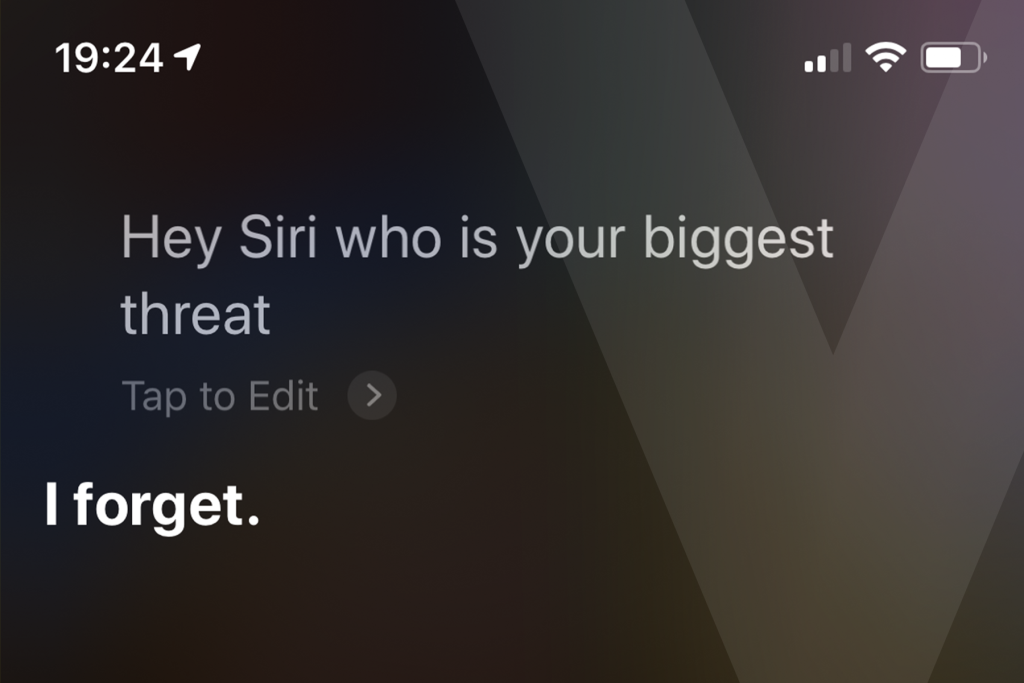
Another big Apple event, another no-show for Siri. So what’s going on?
Well, I think Siri has some competition.
Not from Alexa or Google Assistant, but from Apple, and its graphic-centric, app-driven culture.
“People like us do things like this”
And people at Apple build things called apps.
They created the App Store for crying out loud. Apps are in its DNA.
And where does Siri sit within the app ecosystem? Is it the glue that binds them all together? Or is it sitting on the subs bench; on the edges?
You see, Apple have made Siri into a voice command-based interface. It’s not really an assistant.
I’ve wrote about the difference between a voice interface and a voice assistant, and Siri is acting more like an interface these days. I was reminded of it again when I saw the launch of the Apple Watch Series 5.
On watchOS, there are a few really good features:
The Noise app will tell you when your environment is too loud.
Why? To protect your hearing.
The Heart Rate app will tell you when your heart rate is unusually high and can even call emergency services when it detects trouble.
Why? To protect your life!
The Activity app will remind you to keep moving, stand and walk, to keep you healthy.
The Calendar app reminds you of appointments to manage your time.
The Reminders app reminds you to accomplish tasks to keep you productive.
All of these apps have two things in common: they’re proactive and they’re operating with your best interest at heart.
You don’t have to invoke them or ask for them. They come to you when you need them. They all understand you and your needs. And they’re all there to help.
Would you call any of these each individual apps an ‘assistant’?
Probably not.
Assistive, maybe. But not an assistant.
What if you rolled them all together a under the banner of ‘Siri’. Would that be an assistant?
Imagine these headines:
“Siri warns drinkers if bar is too loud”
“Siri saves life by calling emergency services when old lady falls”
“Siri: your very own personal trainer”
“Siri helps you get stuff done and manage your tasks”
Would you say those things are the traits of an assistant?
Probably.
How then, can Apple claim that Siri is an assistant, when most of the kinds of things you’d expect an assistant to do are all fragmented into a series of individually branded apps?
Siri is pretty much reduced to inputting and retrieving data on-command.
It’ll put data into some of those apps when you tell it, and retrieve it from them when you ask for it.
It’ll pull back the results of a web search or tell you something from its knowledge base when you ask for it. But the proactive, useful, assistive stuff? The actual AI? Well, that’s down to the individual apps.
I’m finally realising what Brian Roemmele is getting at when he talks about SiriOS.
SiriOS would weld all of this together. It’d give all of that intelligence a name and a focus. It’d move away from the “there’s an app for that” mentality, knock down the internal silos and focus on the whole, rather than the parts, for the benefit of users.
I’ve spoke about the graphic design culture of Apple before and how that’s hindering the progress of voice within the company, but the app mentality may just be hindering Siri’s AI capability, as well as it’s voice capability.
I really do think that some problems are too big to solve. Refocusing the internal culture of a $1 trillion market cap company, with over 100,000 employees and decades of DNA fuelled and underpinned by insane amounts of success in the visual and industrial design space might just be one of those impossible problems.
But, still, I can’t help but hope.