

In our previous article, we looked at the rapidly developing market for AI agent testing. There are now plenty of tools that can evaluate individual aspects of an agent. But tools alone don’t create a testing strategy.
So what does a good AI agent testing approach actually look like?
When is my AI Agent ready to go live?
The first step is knowing what “ready” means.
A testing approach should give teams a consistent way to prove that an agent meets the standards expected of it before it reaches customers. That means defining what should pass, what constitutes a failure, and what evidence needs to be recorded.
Testing should not be a final hurdle, it should run throughout the development lifecycle.
Step 1: Test the build before you stress it
The first stage is development testing.
Start with the fundamentals:
- Can the agent complete the intended journey?
- Is its content accurate?
- Do exit points work?
- Can it understand different ways of expressing the same request and route them correctly?
These tests establish that the agent does what it was designed to do.
A failure here is a defect to fix, not something to carry into the next stage.
Step 2: Test what happens when customers don’t cooperate
Once the designed journeys work, the agent needs to be tested under less predictable conditions that more closely reflect real-world user interactions.
- What happens when a customer changes their mind or makes mistakes?
- Asks a side question?
- Gives a long or unclear answer?
- Becomes frustrated? Repeats themselves?
- Tries to push the agent outside its boundaries?
This is where stress testing comes in.
Correction, persona, consistency and red-team testing help expose behaviours that a straightforward happy-path test will never find.
One sequence, not a collection of disconnected tests
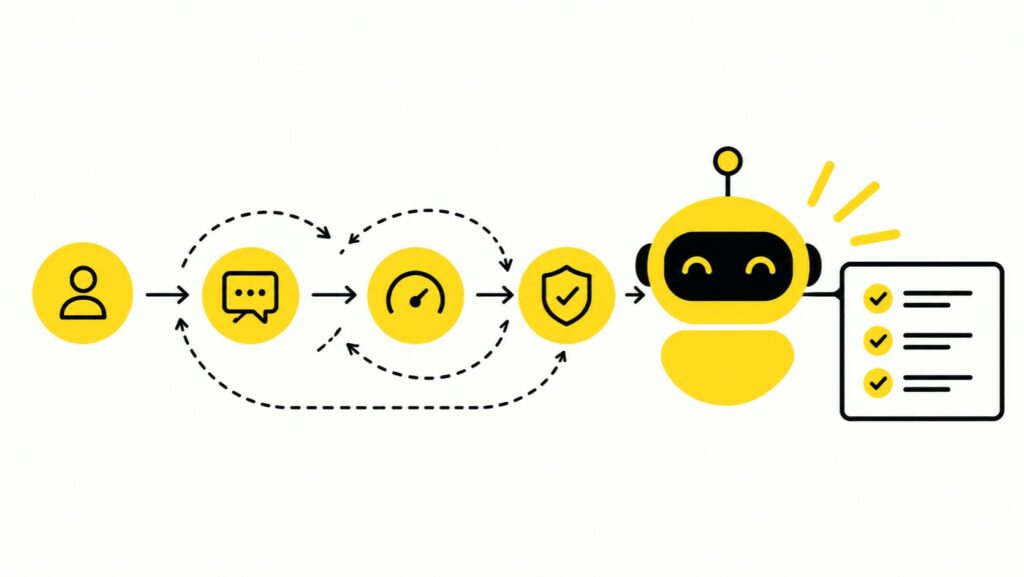
The important point is that these tests work together.
A happy path establishes the intended outcome. Content validation checks that the agent is saying what it should. Exit testing checks that there is a safe way out. Stress testing then challenges the journey once it has been proven to work.
Each layer answers a different question, and each builds on the one before it.
Testing doesn’t stop at go-live
Even a thoroughly tested agent will encounter new situations once it reaches real customers.
That means production insights need to feed back into testing. The result is a continuous loop:
Design → Build → Test → Stress → Go-live → Monitor → Refine → Test again
The goal is confidence, not just coverage
A mature testing approach isn’t about accumulating the biggest possible number of test cases.
It’s about being able to answer a much more important question:
Can we demonstrate that this AI agent is ready for real customers?
This means defining what must pass, what can be accepted, and what constitutes a blocker. Development testing should pass in full before moving to stress testing, which stress testing findings should be assessed by severity. Go-live should not depend on a percentage score, but on agreed standards, evidence and the absence of critical blockers.
Want to see how your current testing approach measures up? Explore our AI Agent Testing Evaluation in a few minutes here.